





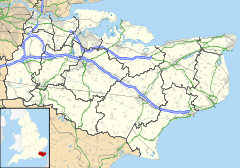
 Canterbury (lat. Cantuaria) – one of the oldest cities in England, the first mention of which dates back to the distant 567-th year. It is located in Kent, less than a hundred kilometers from London. This city bears the honorary title of chair of the high priest of the country – the Archbishop of Canterbury. The city’s population is only about 40,000 people, however, the city world famous, thanks largely to the Canterbury tales, written by Geoffrey Chaucer in the fourteenth century, and the city’s Cathedral.
The history of Canterbury begins during the beginning of our era. Archaeologists have repeatedly found traces of a living primitive people, mainly utensils and tools. According to some sources, this area was captured by the Roman soldiers in the first century of our era, and before that there were brythonic Cantiaci tribe. According to another theory, these same territories were occupied by Gallic tribes, who founded a fortress there. Anyway, in the end, on the site of modern Canterbury, there was the Roman city of Durovernum Cantiacorum (Durovernum Cantiacorum), which can be roughly translated as the fortress of he is sure to break. Architecture of the Roman occupation brought the city a lot of good, because there he built a theatre, forum, temple, and even baths. Already in the III-rd century, the city was surrounded by a fortified wall, built to protect from the barbarians. After approximately two centuries, with the fall of the Roman influence was waning and the city, the main reason was a sharp decline in population. However, after some time, the city was re-inhabited, but this time the Anglo-Saxon tribes, changing its name :
Centerburg (Cantwara burh), which has taken root by the middle of the VI century. But the real heyday of the city brought the spread of Christianity. In this era of Canterbury briefly became the capital of the Kingdom of Kent, but most importantly, the deserted Roman temple was converted into a Church soon, namely at the beginning of the VII century, became the chair for the Archbishop of Canterbury. The final recognition of Canterbury as the spiritual capital occurred in 672, the year when at meeting of archbishops, it was decided to accept the Archbishopric of Canterbury, the dominant position in English religious system. With the development of the spiritual significance of the city grew, and others, in particular the economy and the population, which by the early ninth century was already a few thousand people, and at that time it was a very large figure. From the mid-ninth century, and since the end of the tenth city is constantly subject to attacks of the Vikings, in particular the death of a Martyr killed the Archbishop of Alfie. Because of this, when in 1066, the year the city was attacked by William the Conqueror, resistance was not provided. However, twenty years later, the city was able to recover and restore the pace of development, in particular its population was of 6,000 people. At the end of XII-th century the confrontation between king Henry II and Archbishop Thomas Becket, which ended in 1170 with the death of the latter. Largely because of this Canterbury became known not only throughout England but throughout the world, becoming a place of pilgrimage. Perhaps, the time of religious holidays never had such a demand for houses in England, as at Canterbury, which also brought a lot of money in the coffers of the city. It is the pilgrimage dedicated to the “Canterbury tales” of Geoffrey Chaucer, however, they are shown and not the bright side, inherent in that time. In the time of Chaucer Canterbury was the tenth largest population in England of 10,000 people. However, the plague claimed the lives of more than 70% of the population. In the subsequent two centuries have been many surges in the relationship between the Church and the authorities that did not prevent the town was to develop trade and production. This lasted until the XVIII-th century, when Canterbury lost its status as an important trading center. At the same time changed the appearance of the city : everywhere began to appear typical of houses in England facades. The industrial revolution has adversely affected many of the monuments of history and culture, many of which were used in a completely alien to the original plan and purpose. Only at the end of the XIX-th and early XX-th century the city returned to a path of comprehensive development, the population had reached 24,000 people, and the city again began construction.
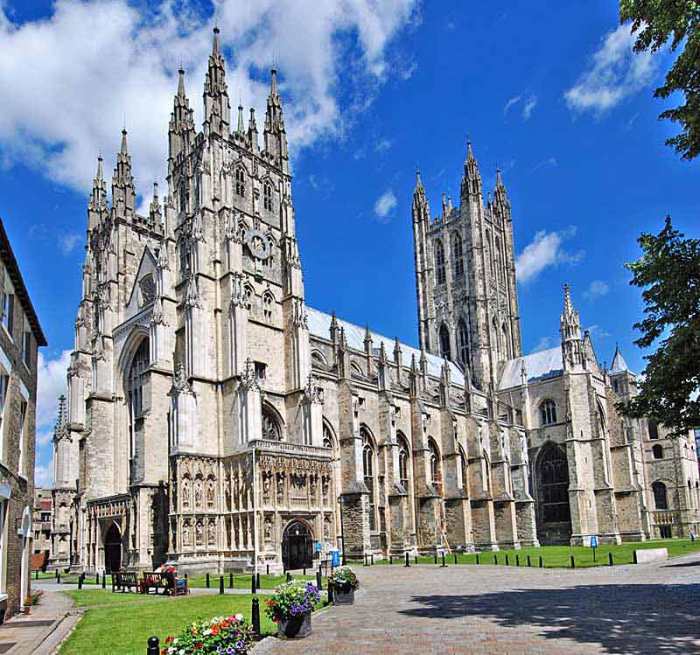
The most famous landmark of the city, of course, is the Canterbury Cathedral. It was founded by then-Bishop Augustine in 602 the year, received the name Cathedral of Christ the Savior. Still remained part of the beautiful stained glass Windows, created in the XII-th century. In 1174, the year the fire occurred, which destroyed a considerable part of the Cathedral, but in the next few centuries Canterbury Cathedral has been successfully reconstructed, moreover, added to his new buildings. The architecture of the Cathedral is a combination of not only a large number of separate chapels and premises, but also of various styles typical of the different eras, particularly the Eastern part contains the traces of the Romanesque style. Stained glass Windows belonging to the Cathedral of Canterbury, are true works of art. They depict scenes from the Bible, and some historical figures. Later was built the tower, which from a purely English style is closely intertwined even the French. Around the Cathedral there is a considerable number of the most beautiful gardens. Canterbury Cathedral is the burial place of many bishops, and also the August persons – Henry IV-th, his wife, and the Black Prince. Not far from this magnificent Cathedral is the Roman Museum, the famous floor mosaic. Besides that, there are a lot of amazing places, like the gates of Christ Church, or the whole area that immerses every visitor into a medieval atmosphere, after all, the house there built in the Tudor style. Also in Canterbury is the Church of St. Martin, founded by Bertha of Kent, and St Augustine’s Abbey.
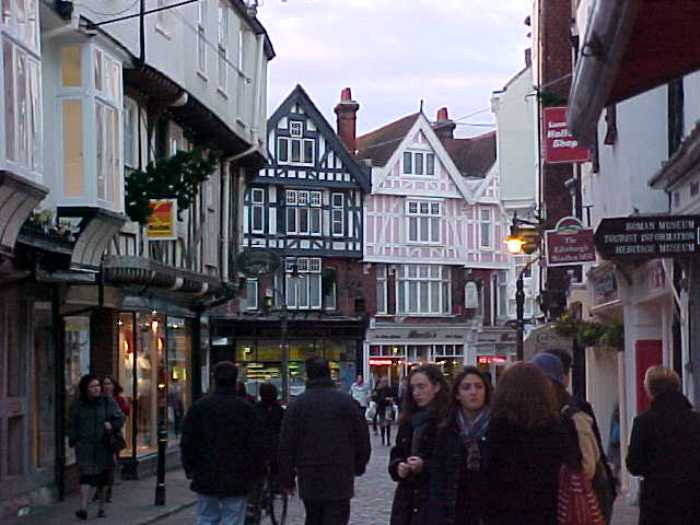
In Canterbury there are even streets separated by canals, between which movement is possible only on a boat that is more suited to Venice than style, popular among the UK real estate. In spite of the abundance of borrowings from other cultures, Canterbury retains its own unique flavour for many centuries, attracting many tourists.
®Mark Saruhanov

New project for investment in Canary Wharf


Vertus, the operator of real estate Canary Wharf Group, has presented the first building of its project "Build-to-Rent" , which...


Studio apartment with one bedroom in the city of Swindon – £95000
Developers who create this project, very proud of their brainchild. It is no coincidence, because it is located in...


Apartment in Swindon one bedroom – £116000
Stylish and modern new one bedroom apartment occupying a spacious 38 sq. m. View on map Located in the...


House in Plymouth 3 floors 4 bedrooms £185000
Half the house has 3 floors, four bedrooms with an area of 102,67 sqm £185000, built-in garage and a garden...